 Orcafinance
: Fixed and Adaptive Pool Fees
Orcafinance pool fees on Solana use either a fixed rate or an adaptive rate that can exceed the base tier. Both apply to the input token in each pool that a swap uses. The rate, trade size and route composition determine trading fees; liquidity-provider earnings also depend on trading activity and active liquidity.
Updated -Browse the sections
The variable component separates the pool types
An adaptive pool combines its base fee tier with a component that responds to recent price movement and volatility. The effective fee may rise above that base as those conditions intensify. During calmer periods, it may sit closer to the base rate. A fixed-fee pool applies its selected tier to each swap through that pool.
A low displayed rate alone does not identify a fixed-fee pool. The distinction rests on whether the pool uses a variable fee component. Adaptive Fee Pools are a type of Whirlpool, Orca's concentrated-liquidity pool. Both fixed and adaptive structures remain available where supported.
Pool parameters and the fee split
The published Solana fee-tier table lists base rates from 0.01% to 2%, each linked to a tick spacing. An adaptive pool can charge above its own base tier. The allocation shares divide the trading fee that the pool collects, rather than the entire amount supplied for the swap.
| Fee parameter | Applicable rate or basis |
|---|---|
| Fixed pool rate | The pool's selected fee tier |
| Adaptive base rate | The pool's selected fee tier |
| Adaptive effective rate | Base fee plus a dynamic component that may increase with price movement or volatility |
| Fee asset | The input token for the swap through that pool |
| Liquidity-provider allocation | 87% of the collected trading fee under the published split |
| Protocol Treasury allocation | 12% of the collected trading fee under the published split |
| Climate Fund allocation | 1% of the collected trading fee under the published split |
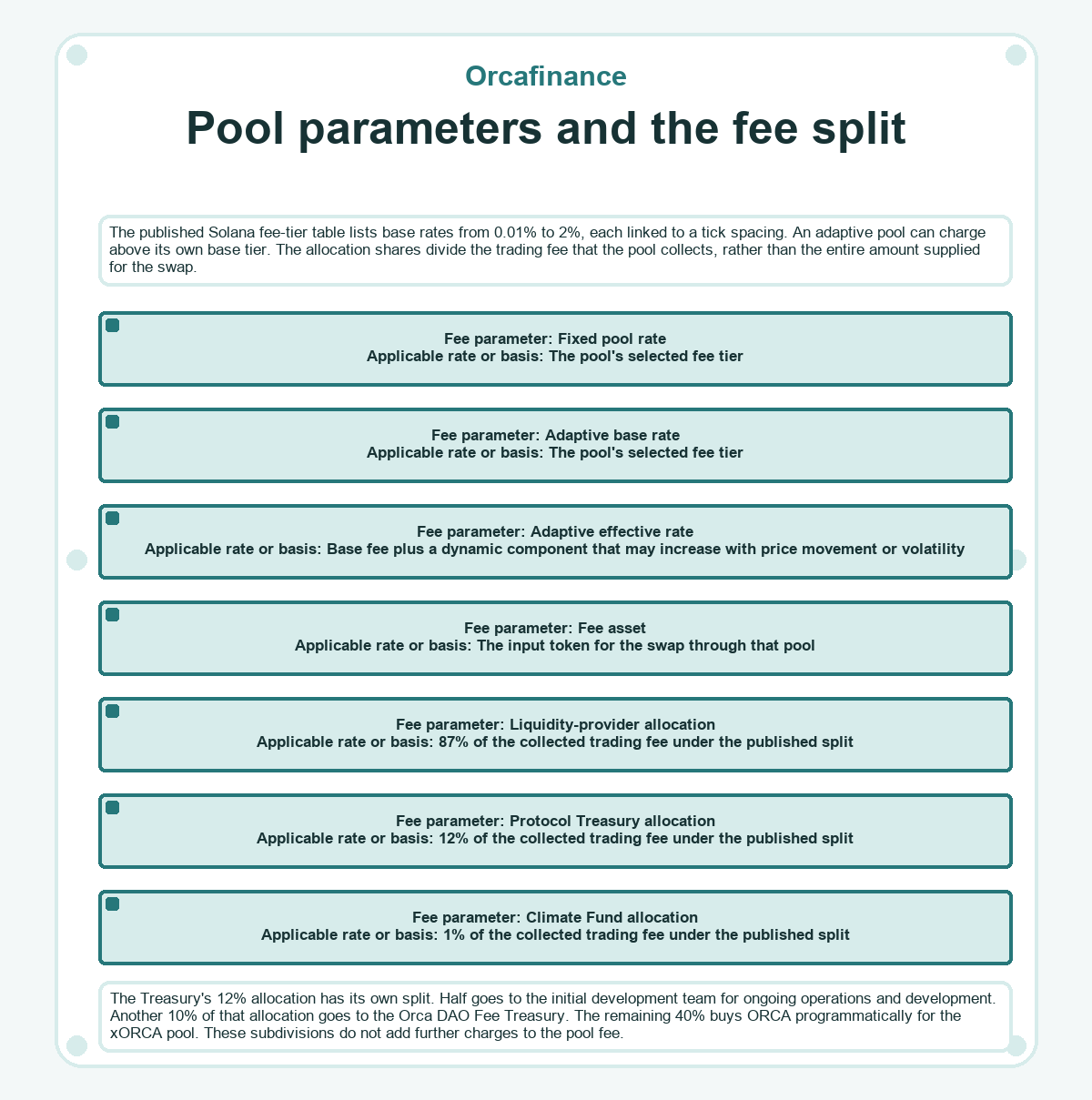
The Treasury's 12% allocation has its own split. Half goes to the initial development team for ongoing operations and development. Another 10% of that allocation goes to the Orca DAO Fee Treasury. The remaining 40% buys ORCA programmatically for the xORCA pool. These subdivisions do not add further charges to the pool fee.
Does a higher fee tier mean higher LP returns?
A higher pool fee does not establish a higher return for liquidity providers (LPs). Trading activity and the position's active liquidity also determine fee income.
A position accrues swap fees only when trades use its liquidity within the selected price range. More trading activity can generate more fees when it uses that liquidity. A narrower range may capture a larger share of active liquidity, but smaller price movements can push it out of range. Range width and fee structure describe different properties of the same liquidity opportunity.
An out-of-range position stops accruing swap fees while the pool price remains outside its bounds. Its token composition may become fully one-sided, and those tokens can lose value. Fees may fail to offset divergence from holding the deposited tokens, transaction costs or token-price losses. A larger fee percentage therefore cannot establish the position's overall profitability.
Additional token rewards are separate from swap fees. Some pools offer them, and their availability or amounts can change.
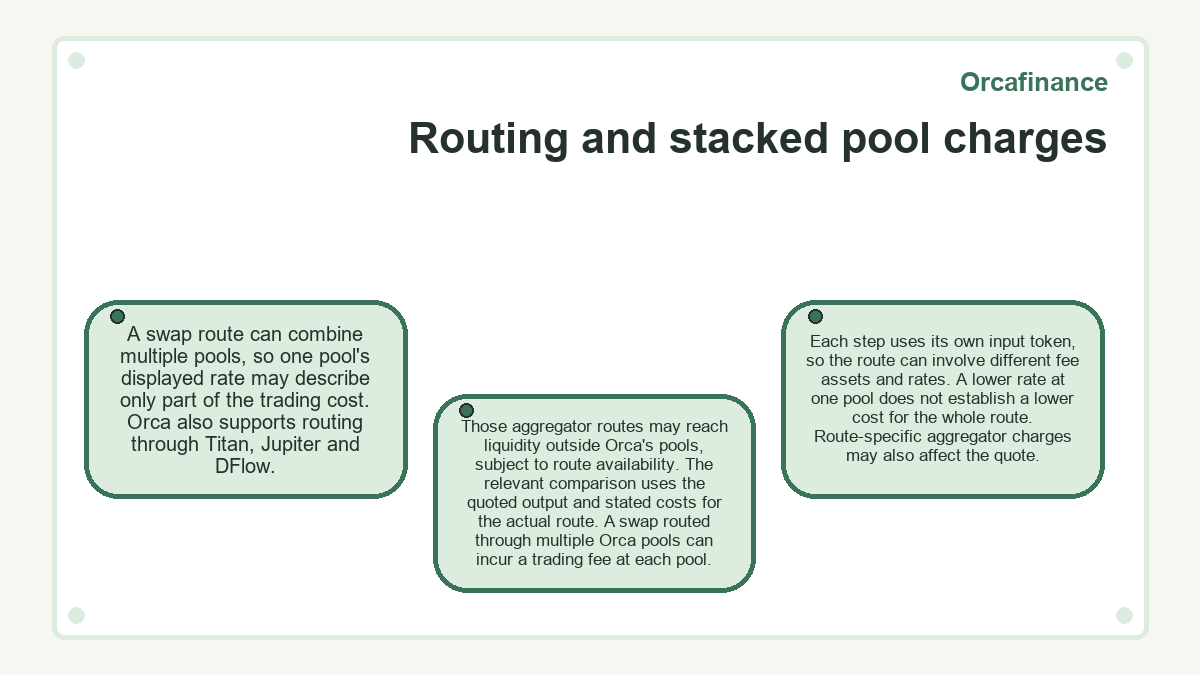
Routing and stacked pool charges
A swap route can combine multiple pools, so one pool's displayed rate may describe only part of the trading cost. Orca also supports routing through Titan, Jupiter and DFlow. Those aggregator routes may reach liquidity outside Orca's pools, subject to route availability. The relevant comparison uses the quoted output and stated costs for the actual route.
A swap routed through multiple Orca pools can incur a trading fee at each pool. Each step uses its own input token, so the route can involve different fee assets and rates. A lower rate at one pool does not establish a lower cost for the whole route. Route-specific aggregator charges may also affect the quote.
Price impact and slippage tolerance
Price impact describes the estimated effect of trade size on the quoted exchange rate; slippage concerns movement between quoting and execution. A pool fee represents a separate charge. Larger trades or routes with less liquidity may have higher price impact. A low trading-fee rate can therefore accompany a less favorable quoted exchange rate.
Slippage tolerance sets transaction limits without changing the pool's fixed or adaptive fee structure. The minimum received amount reflects that tolerance. Increasing tolerance accepts a wider range of execution outcomes and may increase execution risk. Comparing pool rates requires keeping those limits distinct from the fee itself, alongside the quoted output and the route that supplies it.
Network costs outside the trading fee
Solana network fees pay for transaction execution separately from the percentage that a pool charges on its input token. Priority fees may also apply, depending on network conditions. These costs belong to different layers, so a fixed pool rate does not make the total transaction cost fixed. SOL must remain available for network fees and any required account costs.
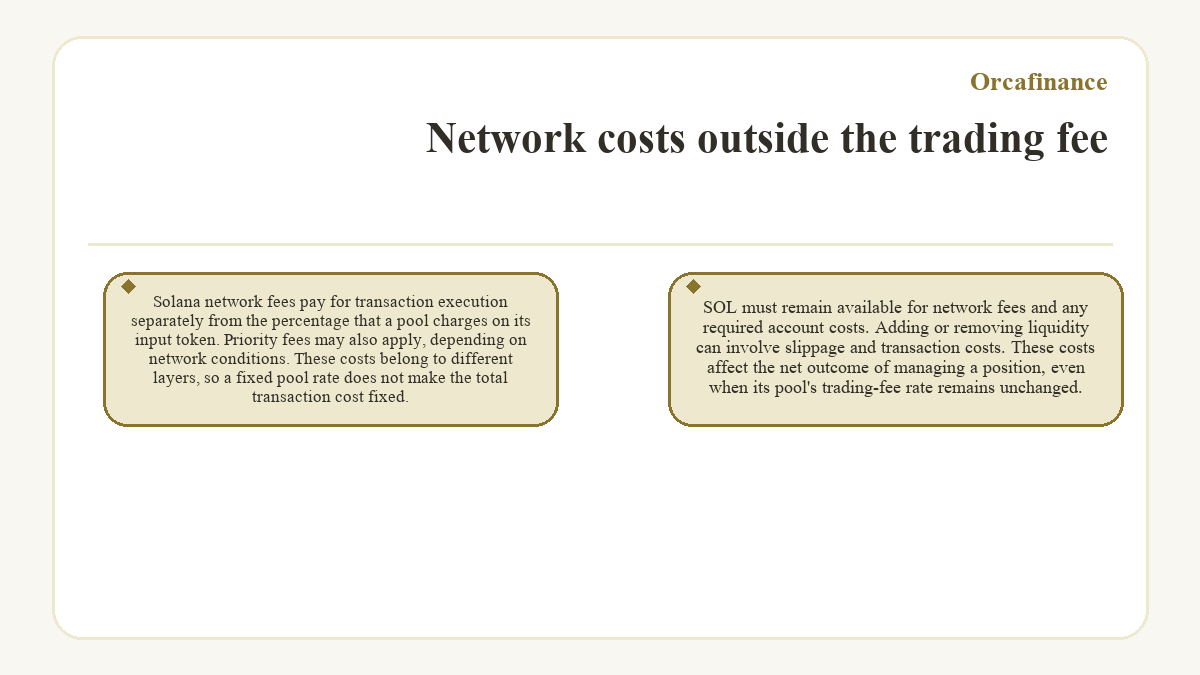
Adding or removing liquidity can involve slippage and transaction costs. These costs affect the net outcome of managing a position, even when its pool's trading-fee rate remains unchanged.
Pool fees and position-level earnings
Fees 24H describes the pool's displayed fees over the preceding 24 hours; a position's Pending Yield shows accrued but unharvested fees and rewards. The pool-wide figure does not belong to a single position. Individual fee accrual depends on active liquidity, range and trading activity, while Pending Yield may include rewards beyond swap fees.
The Liquidity Terminal also displays 24-hour trading volume alongside pool fees. That measurement window matters when comparing activity across pools. Portfolio position rows offer estimated yield with a selectable timeframe, rather than one universal measurement period. These estimates use available data and can change with market conditions. Pending Yield, by contrast, identifies fees and rewards that have already accrued.
Fee settings and pool creation costs
Pool creation has a separate cost basis from the trading-fee model selected for the new pool. Orca charges no pool-creation interface fee. Creation can still require Solana network fees, account costs and applicable Metaplex-related costs. These setup costs differ from the trading fees that swaps subsequently generate.
The pool creator chooses the fee tier, and a tier can have more than one associated tick spacing. The same selection has different roles in the two fee models. A fixed-fee pool uses the chosen tier as its trading rate; an adaptive pool uses it as the base for a rate that can rise with price movement.
Practical questions
Can I delete a newly created pool if its fee setting is unsuitable?
A pool cannot be deleted after creation, so review its fee tier and other setup details before confirming the creation transaction.
Where does Orca display an adaptive pool's effective fee?
An adaptive pool's Create Position panel shows an Adaptive Fees Enabled banner with the current effective rate. That figure includes the adaptive component and can change with pool conditions. The Pools page also has an Adaptive Fees filter for finding pools that use this fee model.
What does the fee tier on a vault page describe?
The fee tier on a vault page describes the underlying Whirlpool that the vault uses. It does not establish the vault's complete cost structure or expected yield. The same page identifies the vault provider as the strategy operator, distinguishing strategy management from the pool's swap-fee model.
Does Orca add an interface fee to standard swaps?
Orca does not charge an additional interface fee for standard swaps. Trading fees still vary with the pools and route used. Solana network fees, priority fees and route-specific costs may also apply, so the absence of an interface charge does not make a standard swap free.
Why can adding liquidity require more SOL than expected?
Some liquidity transactions initialize tick arrays or other onchain accounts, which can increase the SOL required for network or account costs. These costs differ from the trading fee charged on swaps through the pool. A fixed pool fee therefore does not imply a fixed SOL cost for opening or changing a position.
What happens if execution cannot meet the displayed minimum received amount?
The swap should fail if execution cannot satisfy its minimum received amount. That amount reflects the selected slippage tolerance. Raising tolerance accepts a wider price limit; it does not remove pool fees, route costs or price impact. An updated quote matters before another attempt because route availability and market conditions can change.
Is the Position Simulator's estimated fee yield annualized?
The Position Simulator's Estimated Yield uses the selected timeframe and is not annualized. It expresses an estimated fee return as a percentage of deposit value. Estimated Yield Earned is a different metric tied to modeled Time In-Range, which represents time within the selected range rather than total elapsed time.